 EN
EN


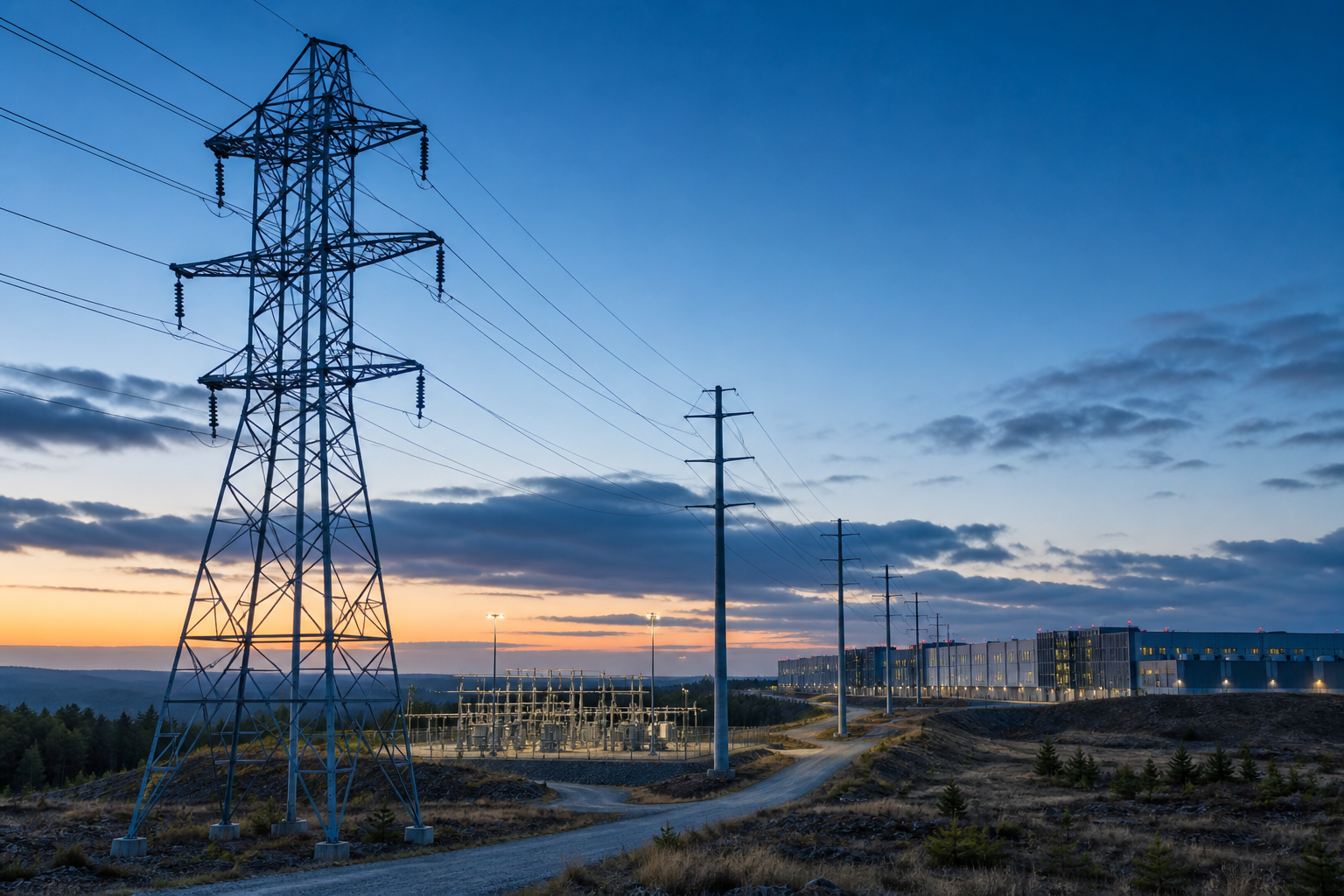
Artificial intelligence may run in the cloud, but the physical infrastructure behind it depends on electricity delivered through real substations, conductors, transmission towers, and utility poles. As AI-focused data centers expand, power availability and grid connection schedules are becoming critical parts of site selection and project planning.
The International Energy Agency reported in 2026 that global electricity demand from data centers grew by 17% in 2025. Its central outlook sees data-center electricity consumption increasing from 485 TWh in 2025 to approximately 950 TWh in 2030. The IEA also notes that most data centers prefer to connect to the grid, even as grid-connection bottlenecks encourage some developers to examine on-site generation and storage.
These figures describe an industry trend, not the design basis for an individual power line. Every transmission or distribution project still requires confirmed load forecasts, grid studies, route surveys, voltage selection, electrical clearances, structural calculations, geotechnical information, environmental review, permits, and utility approval. Within that process, power transmission towers and steel utility poles form the physical corridor that moves power from generation and substations toward high-demand sites.
1. Why AI Infrastructure Is Also Power Infrastructure
AI training, inference, cooling, networking, and data storage create substantial and often concentrated electrical loads. A new data-center campus may require more than an internal electrical system. Depending on the utility network and site location, the project may also involve new substations, reconductoring, transmission-line extensions, sub-transmission feeders, distribution upgrades, or entirely new grid corridors.
The U.S. Department of Energy reported in 2024 that data-center load growth had tripled over the previous decade and could double or triple by 2028. The U.S. Energy Information Administration also projected record electricity consumption in 2025 and 2026, with expanding large computing facilities among the drivers. Such forecasts help explain why grid capacity, connection queues, transformers, switchgear, conductors, and line structures are increasingly discussed alongside servers and chips.
For project developers, the practical question is not simply how much electricity the data center will use. It is how the required capacity can be connected, transmitted, transformed, distributed, protected, and expanded over the project life.
2. Where Power Towers and Utility Poles Fit in the Connection Path
A data-center power connection can involve several network levels. The exact arrangement depends on the available grid, required capacity, redundancy strategy, distance to the connection point, and utility requirements.
Power transmission towers are commonly used for overhead high-voltage corridors where long spans, multiple circuits, heavy conductors, significant electrical clearances, or challenging crossings must be accommodated. Steel utility poles may be used for transmission, sub-transmission, or distribution applications when a compact footprint, reduced visual width, roadside alignment, or specific urban and industrial constraints are important.
These structures do not determine the electrical scheme by themselves. They support the conductors, shield wires or optical ground wires, insulator strings, fittings, and other equipment defined by the line design. Their geometry and strength must match the electrical and mechanical requirements of the complete system.
3. Lattice Power Towers: Flexibility for Major Corridors
A lattice power tower uses a framed steel structure assembled from multiple members and connections. This form can support a wide range of line arrangements when designed for the project requirements.
Typical Roles
Lattice towers may be considered for long transmission routes, multi-circuit configurations, line angles, terminal locations, major crossings, or sections where substantial conductor and environmental loads are expected. Different tower families can be developed for suspension, angle, tension, transposition, and terminal duties.
Why Tower Families Matter
A transmission line is rarely built with only one tower type. Straight sections may use suspension towers, while route deviations and section endpoints require structures capable of resisting different longitudinal and transverse forces. Crossing locations may require special heights or spans. A rational tower family helps balance safety, steel weight, fabrication repetition, construction efficiency, and maintenance.
For AI-related grid expansion, this matters because compressed schedules can create pressure to start procurement early. However, ordering a generic tower before route geometry, conductor data, loading cases, and tower spotting are sufficiently defined can cause redesign and delay rather than saving time.
4. Steel Utility Poles: Compact Structures for Constrained Routes
Steel utility poles provide a narrower visual and physical footprint than many lattice structures. Depending on the project, they may support distribution, sub-transmission, or transmission circuits in industrial parks, roadsides, urban corridors, and compact interconnection routes.
Project Advantages
A steel pole system can simplify the corridor where right-of-way width is limited. Factory-fabricated pole sections, flange or slip-joint arrangements, bracket systems, and controlled surface protection can support repeatable installation. The cleaner profile may also suit sites where appearance and land use influence route approval.
Engineering Boundaries
A compact footprint does not mean a simple design. Pole shaft geometry, wall thickness, connections, base plates, anchor bolts, crossarms, conductor attachment points, deflection, foundation reactions, transport lengths, lifting plans, and field assembly must all be coordinated.
For a data-center feeder or substation interconnection, the decision between lattice towers and steel poles should be based on electrical configuration, route constraints, loads, constructability, maintenance, local standards, and total installed project requirements—not appearance alone.
5. Tower or Pole: How Should a Project Choose?
The most appropriate structure depends on the whole route. A useful comparison should consider:
- Required voltage level and electrical clearances.
- Number of circuits and conductor arrangement.
- Conductor, earth wire, and optical ground wire data.
- Normal span, ruling span, wind span, weight span, and special crossings.
- Route angles, terminal loads, and longitudinal unbalanced conditions.
- Wind, ice, temperature, seismic, terrain, and topographic conditions.
- Right-of-way limitations and access for construction.
- Soil conditions, groundwater, uplift, and foundation constraints.
- Corrosion environment and surface-protection specification.
- Transportation limits, erection equipment, labor, and schedule.
- Inspection, maintenance, future uprating, and line reliability requirements.
In open corridors with substantial loads and multiple structure duties, lattice towers may offer flexibility. In compact industrial or roadside corridors, steel poles may reduce footprint. Many projects use both, selecting each structure according to its location and function.
6. Structural Loads Behind Modern Power-Line Deployment
A power tower or pole must resist more than the vertical weight of conductors. Depending on the governing standard and project specification, the structural design may consider wind on the structure and wires, conductor tension, broken-wire or unbalanced conditions, ice where applicable, construction and maintenance loads, temperature effects, seismic actions, and combinations associated with different tower duties.
The line geometry also affects structural demand. Longer spans, larger conductors, heavier optical ground wires, greater route angles, and special crossings can increase loads. The attachment height and conductor arrangement influence moments and member forces. Foundation reactions must be coordinated with verified geotechnical conditions.
For this reason, tower height and quantity alone are not enough for a final quotation. A preliminary budget may use assumptions, but those assumptions must be clearly listed and replaced with project data before final engineering and production.
7. Grid Reliability Matters for High-Demand Digital Infrastructure
Data centers need dependable power quality and continuity. The line structure is only one element of reliability, but its design, fabrication, corrosion protection, connections, foundation interface, and construction quality directly affect the physical integrity of the corridor.
Reliability planning may include multiple supply paths, separate substations, redundant circuits, protection coordination, energy storage, demand response, or on-site generation. The appropriate arrangement is decided by utilities and project engineers. Power towers and poles must support the approved network configuration and the required line clearances under the specified load cases.
AI can also help utilities forecast loads, inspect assets, and operate networks more efficiently. However, digital optimization does not remove the need for physical grid investment where existing capacity or connectivity is insufficient. Software and steel infrastructure increasingly need to be planned together.
8. Route Planning and Permitting Can Control the Schedule
The manufacture of towers and poles is only one part of a power-line project. Route selection, land access, environmental studies, utility interconnection studies, permits, public consultation, surveys, geotechnical work, foundation design, conductor procurement, substation equipment, construction access, testing, and energization can all affect the schedule.
A data center may be developed faster than a new grid corridor can be approved and built. Therefore, early coordination is important. The project team should identify long-lead equipment and structural packages while avoiding premature fabrication based on incomplete route or loading information.
A practical procurement plan separates three stages:
- Concept and budget: define the connection objective, possible route, voltage options, preliminary structure families, and major assumptions.
- Design development: confirm surveys, line parameters, loading criteria, tower spotting, geotechnical inputs, structure schedules, and foundation reactions.
- Production and delivery: release approved drawings, material lists, inspection plans, packing schedules, shipping batches, and site erection documentation.
9. Corrosion Protection, Fabrication, and Quality Control
Power-line structures operate outdoors for long periods and may face humidity, salt, industrial pollution, temperature cycles, and difficult maintenance access. The project specification should define the required corrosion-protection system and inspection criteria.
For galvanized steel structures, buyers should clarify the applicable coating standard, material preparation, inspection method, handling, repair procedure, marking, and packing. Fasteners, plates, brackets, pole accessories, and small components should have compatible protection.
Fabrication controls may include material traceability, dimensional inspection, hole and connection checks, welding procedures where applicable, trial assembly requirements, galvanizing inspection, packing verification, and document review. The final inspection plan should follow the contract and project specification rather than a generic product claim.
10. Procurement Information Required for Power Towers and Poles
To receive a useful proposal, the RFQ package should include:
- Project name, country, route location, and destination.
- Line purpose, voltage level, number of circuits, and required capacity basis.
- Route length, alignment drawings, terrain, access conditions, and crossing information.
- Conductor, earth wire, and optical ground wire specifications.
- Span criteria, route angles, structure spotting, and tower or pole schedule when available.
- Wind, ice, temperature, seismic, corrosion, and other environmental criteria.
- Governing standards, utility requirements, and required reliability class.
- Structure types, heights, circuit arrangement, crossarm geometry, and attachment elevations.
- Geotechnical information and the required foundation-design responsibility.
- Material grades, fastener requirements, surface protection, inspection, and documentation.
- Quantity, delivery batches, packing, trade terms, destination, and target schedule.
- Scope boundaries for design, manufacturing, testing, transport, supervision, and erection.
If some inputs are unavailable, the buyer should identify them as pending and request a written assumption list. This makes quotations easier to compare and reduces the risk of hidden scope gaps.
11. How to Compare Manufacturers for an AI-Related Grid Project
A price comparison is meaningful only when suppliers respond to the same engineering basis. Evaluate whether each proposal clearly addresses the structure schedule, design criteria, conductor loads, environmental cases, material specifications, corrosion protection, accessories, engineering documents, inspection plan, packing method, delivery sequence, and exclusions.
For schedule-sensitive data-center projects, also assess how the manufacturer handles design clarification, drawing review, production release, change control, batch identification, and shipping coordination. Fast communication is valuable, but speed should not replace approval discipline or technical traceability.
The strongest proposal is not necessarily the one with the lowest initial steel price. It is the one that makes assumptions visible, matches the confirmed scope, and supports coordinated engineering and delivery.
12. Building the Physical Grid for the AI Era
The growth of AI is increasing attention on generation, transformers, substations, storage, transmission networks, and distribution systems. The pace and location of actual investment will vary by country, utility, market conditions, permits, and project economics. Not every announced data center will proceed, and not every site requires a new overhead line.
Where new corridors or upgrades are required, power transmission towers and steel utility poles provide the structural backbone for moving electricity safely across the route. Their design must follow the approved electrical scheme, environmental loads, surveys, geotechnical conditions, applicable standards, and construction plan.
Request a Power Tower or Steel Pole Project Review
Hebei Junhao Communication Technology Service Co., Ltd supplies power transmission towers, steel utility poles, communication towers, communication accessories, and steel tower structures. For a power-line inquiry, send the voltage level, route length, structure schedule, tower or pole drawings, conductor and ground-wire data, span and angle information, environmental criteria, standards, quantity, destination, and delivery plan.
Contact Hebei Junhao Communication Technology Service Co., Ltd to review the available project information and request a project-based proposal for power towers, steel utility poles, or related line structures.
Table of Contents
- 1. Why AI Infrastructure Is Also Power Infrastructure
- 2. Where Power Towers and Utility Poles Fit in the Connection Path
- 3. Lattice Power Towers: Flexibility for Major Corridors
- 4. Steel Utility Poles: Compact Structures for Constrained Routes
- 5. Tower or Pole: How Should a Project Choose?
- 6. Structural Loads Behind Modern Power-Line Deployment
- 7. Grid Reliability Matters for High-Demand Digital Infrastructure
- 8. Route Planning and Permitting Can Control the Schedule
- 9. Corrosion Protection, Fabrication, and Quality Control
- 10. Procurement Information Required for Power Towers and Poles
- 11. How to Compare Manufacturers for an AI-Related Grid Project
- 12. Building the Physical Grid for the AI Era
- Request a Power Tower or Steel Pole Project Review